A VR system pairing graph-neural-network explanations with LLM-generated narratives, testing whether narrative framing turns explanations from static endpoints into prompts for reasoning.
Instrumenting standardized clinical dexterity tests in XR — automated, clinician-grounded scoring from hand-tracking kinematics instead of stopwatch and clipboard.
A VR training system for precision assembly at Kia, built with Georgia Quick Start: practice scaffolded from stationary stations to the moving line, with embedded performance analytics.
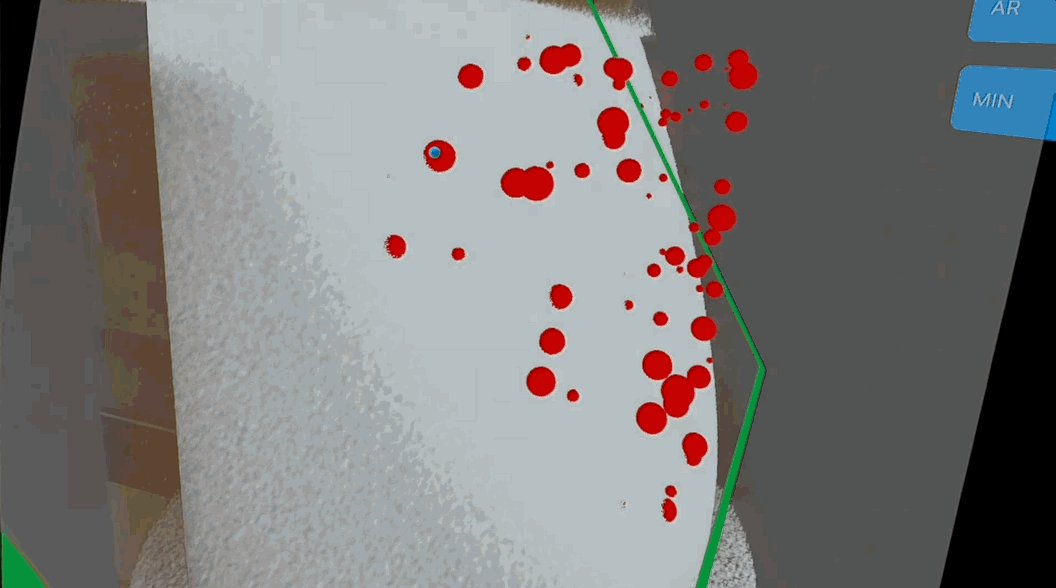
An XR platform for exploring multi-gigabyte X-ray computed tomography volumes with natural two-handed interaction, on PC-VR headsets and Apple Vision Pro.
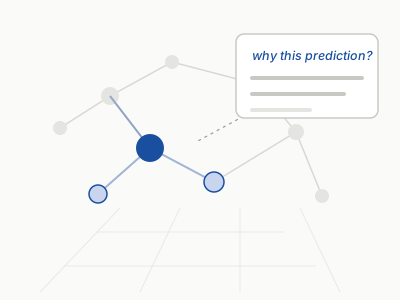
A think-aloud study of how domain experts and AI experts explore visually interactive GNN explanations — and why explanations end up as endpoints rather than prompts for reasoning.
The sociotechnical barriers older adults face in the continual use of digital services, studied through community events offering digital-literacy support.
A UX redesign of UIC’s research-protocol submission website: a personalized, card-based homepage in place of a wall of actions, delivered as an interactive prototype.
A virtual reconstruction of part of the UIC campus for CAVE2 and Vive — day and night scenes, interactable objects, spatial sound, and animated characters, built in Unity.
A Unity study platform for point-and-select performance across seven walking and controller conditions, with a complete experiment design and logging pipeline.
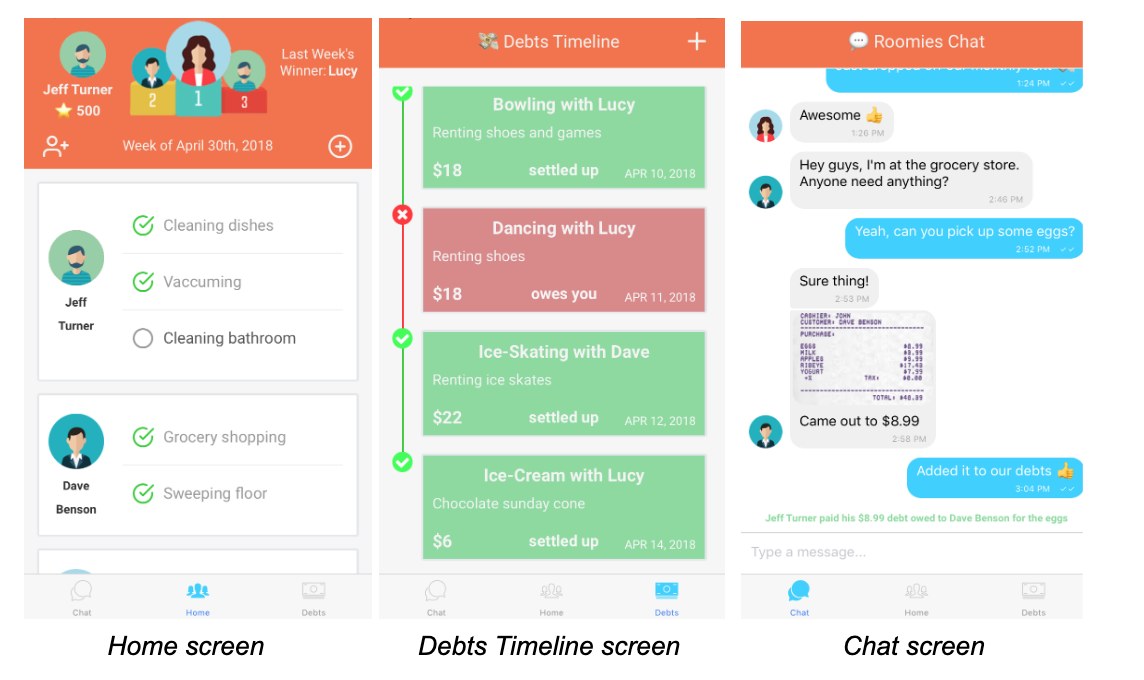
A mobile app that helps roommates divide chores, communicate, and settle debts — taken from personas and sketches through paper prototyping to an evaluated interface.
New hires on an assembly line must reach precision, speed, and quality under real production constraints:
holding a strict 90-degree drill angle while fastening 9–10 bolts in a precise clockwise sequence inside a
51-second cycle, spotting subtle defects like damaged clips or misaligned modules, and executing safety
actions on a moving line. These motor and cognitive skills are hard to build through traditional onboarding
without reducing throughput.
Approach
A gamified VR training system for these skills, with practice scaffolded from stationary
training stations to a full moving-line simulation. Embedded analytics capture drill-angle compliance, bolt-sequence
accuracy, timing, defect recognition, alignment precision, and safety responses, enabling objective
assessment and data-driven progression.
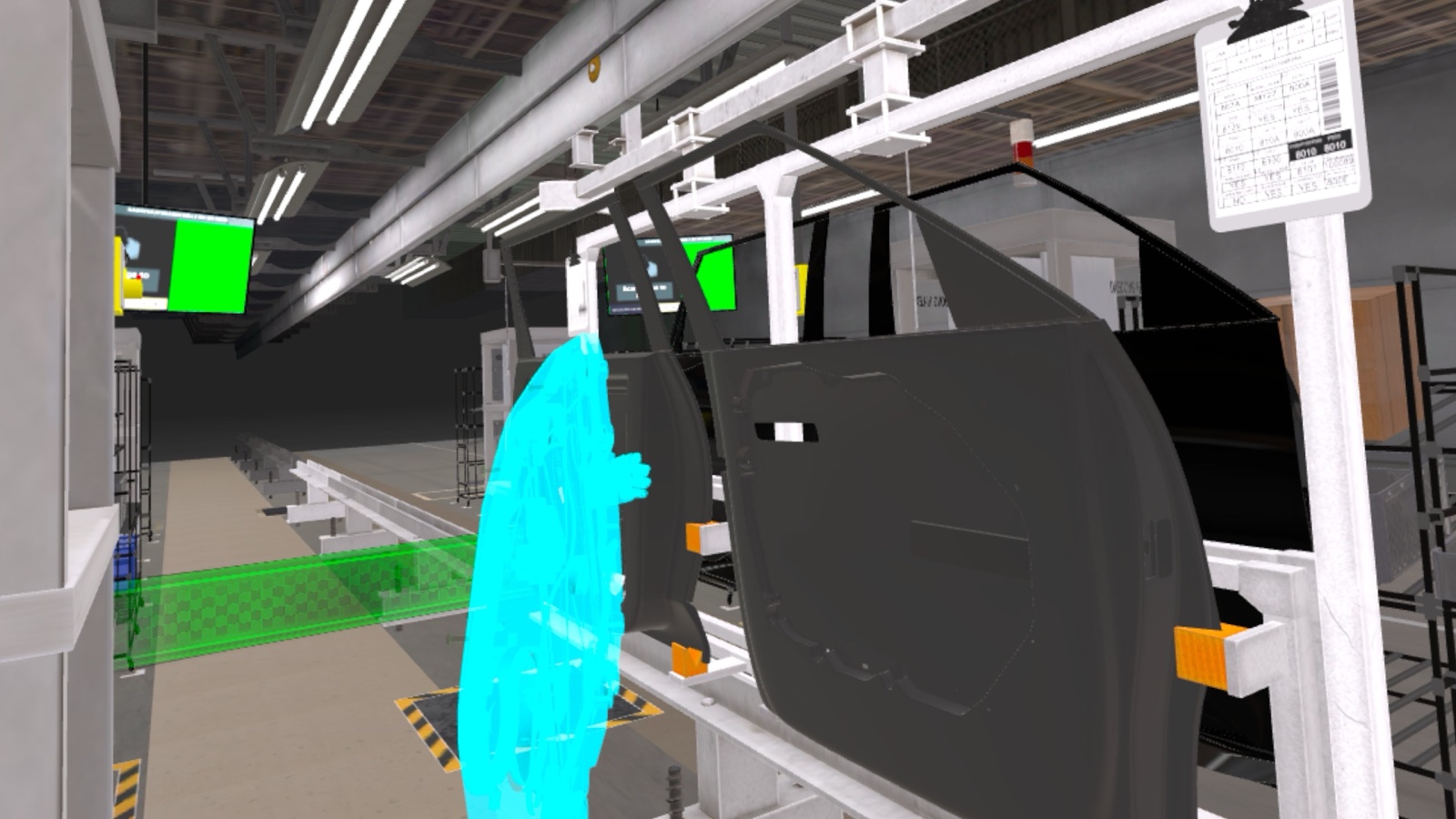
Inside the simulated line during door-module training.
My role
task analysis of the assembly-line skills to be trained
design of the training curriculum and scaffolded practice stages
interaction design for the drilling, parts-handling, and inspection tasks
definition of the embedded performance metrics and analytics
playtesting sessions with trainees and trainers
evaluation planning
Impact
Georgia Quick Start is integrating the system into its training program.
Poster · Manufacturing 4.0 Consortium Meeting, Advanced Manufacturing Pilot Facility (AMPF) Week, Georgia Tech Manufacturing Institute (GTMI), 2026
Habibi, P., Yoo, S., & Moghaddam, M. Manufacturing & Assembly Training in Realistic Immersive Experiences.
Georgia Institute of Technology · 2025
Unity · PC-VR · Apple Vision Pro
Problem
X-ray computed tomography lets materials researchers characterize internal structures — porosity networks,
crack propagation — without destroying the sample. But conventional workflows rely on 2D cross-sections or
3D renderings on flat monitors, and the datasets are large: 2–25 GB volumes with billions of voxels, which
makes real-time interactive exploration hard.
Approach
An immersive visualization platform that ingests multiple volumetric files at once and supports natural
two-handed exploration of the volumes in real time. Built in Unity for cross-platform deployment; runs on
PC-VR headsets and Apple Vision Pro with Metal-based rendering.
My role
design of the two-handed volume-exploration interactions
requirements gathering from expert CT-analysis workflows
Poster · Manufacturing 4.0 Consortium Meeting, Advanced Manufacturing Pilot Facility (AMPF) Week, Georgia Tech Manufacturing Institute (GTMI), 2026
Habibi, P., & Moghaddam, M. XR–CT: Immersive XR Visualization for Large-Scale X-ray Computed Tomography.
Georgia Institute of Technology · 2026
VR · GNN explanations · LLM narratives · study in progress
Problem
Graph neural networks drive decisions in high-stakes domains — healthcare, drug discovery, fraud
detection — yet their explanations show which parts of a graph mattered, not why. Our earlier
studies found that even faithful, well-visualized explanations are treated as endpoints: people read them
and stop reasoning.
Approach
I am building and studying a VR system that pairs interactive 3D graph explanations with LLM-generated
narratives, to test whether narrative framing turns explanations into prompts for reasoning.
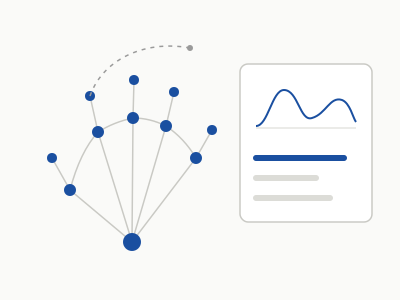
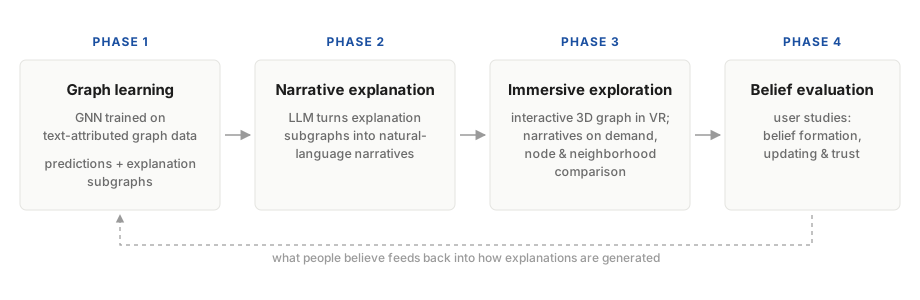
System architecture: from graph learning to belief evaluation, with what people believe feeding back into explanation generation.
My role
principal investigator
system concept and four-phase architecture
building the VR system and the LLM narrative-explanation pipeline
study design and evaluation
In progress; funded by a CoCo Pilot Grant, Georgia Institute of Technology, 2026.
Poster · CoCo Conference, Georgia Institute of Technology, 2026
Habibi, P. Narrative-Driven Immersive Explainability: Bridging Belief Dynamics and GNN Interpretability
through LLM-Generated Narratives in Virtual Reality.
Georgia Institute of Technology · with Shriners Children’s · 2025 – present
XR hand tracking · kinematics · ML scoring · LLM clinical notes
Problem
Clinical assessments of upper-extremity motor function still run on stopwatches and clipboards. Total
completion time obscures the primary clinical concern: the quality of the movement.
Approach
With Shriners Children’s, we are instrumenting standardized dexterity assessments in XR with hand
tracking, and building automated scoring that stays grounded in how clinicians assess movement quality.
My role
task and interaction design of the XR versions of the assessments
design of the kinematic features behind scoring: movement smoothness, planarity, speed, and hesitation
machine-learning scoring of movement quality from those features, grounded in clinical scoring practice
LLM pipeline turning extracted kinematics into structured clinical notes, with LLM-based validation of the outputs
Touchless interfaces implicitly treat the two hands as interchangeable. But mid-air input is physically
demanding, and little was known about how handedness and motor asymmetry shape what each hand can do — on
large displays, in CAVE environments, or with AR/VR headsets.
Approach
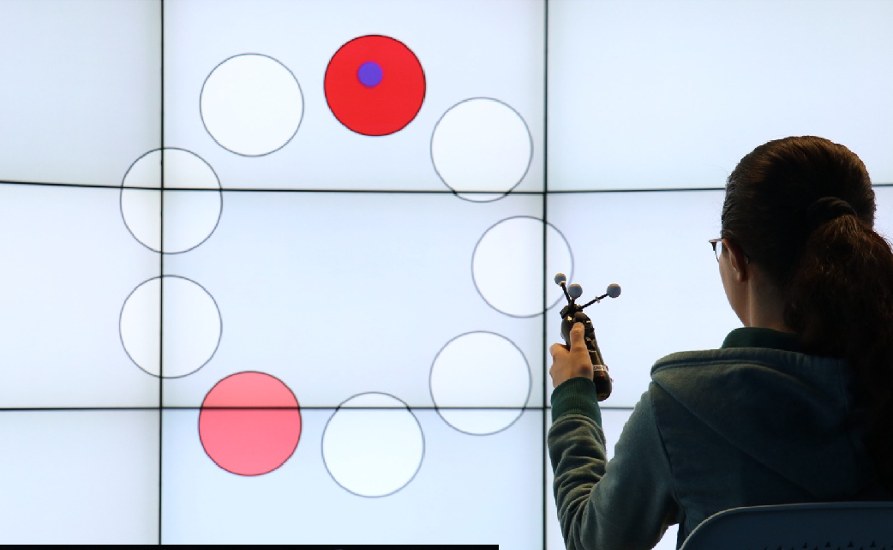
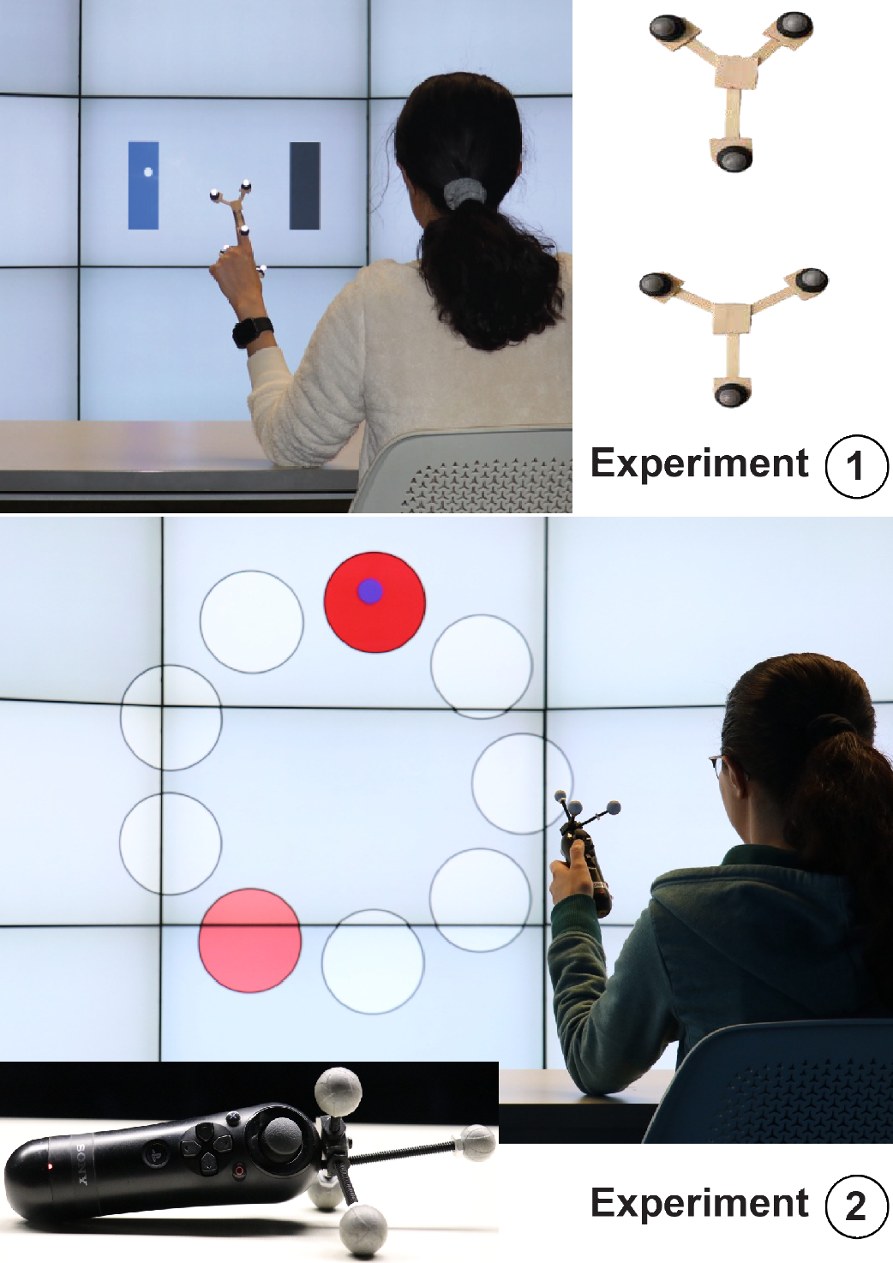
Two controlled experiments (20 participants each, 40 total): freehand touchless and device-based touchless
pointing and dragging on a large tiled display, tracked with motion capture and compared across input types
and hands. Analyses used interaction logs and statistical modeling in R.
From the IJHCS 2021 paper: the two controlled experiments — freehand and device-based touchless input.
Findings
Touchless performance barely degrades between hands: both freehand and device-based touchless input
showed significantly smaller between-hands differences than the mouse or stylus, and structural equation
models traced those differences to how much feedback control an input type demands (IJHCS 2021). An earlier
study also found a left-hand advantage in certain touchless tasks (CHI EA 2019). The findings inform
bimanual and multimodal techniques that involve touchless input.
My role
design of both controlled experiments
study apparatus: motion-capture and large-display setup
data collection with all 40 participants
statistical analysis in R
writing
Publications
International Journal of Human-Computer Studies (IJHCS), 2021
Habibi, P., & Chattopadhyay, D. The Impact of Handedness on User Performance in Touchless Input.pdfelsevier
ACM CHI Conference on Human Factors in Computing Systems, Extended Abstracts (CHI EA), 2019
Habibi, P., & Chattopadhyay, D. A Left-Hand Advantage: Motor Asymmetry in Touchless Input.pdfposteracm
Poster · ACM Richard Tapia Celebration of Diversity in Computing, 2019
Habibi, P. Touchless Performance in Non-Preferred Hands.poster
Poster · Computing Research Association–Women (CRA-W) Grad Cohort Conference, 2018
Habibi, P., & Chattopadhyay, D. Touchless Performance in Non-Preferred Hands.poster
University of Illinois Chicago · 2022 – 2024
controlled studies · n = 20 + 21 · Unity · Quest
Problem
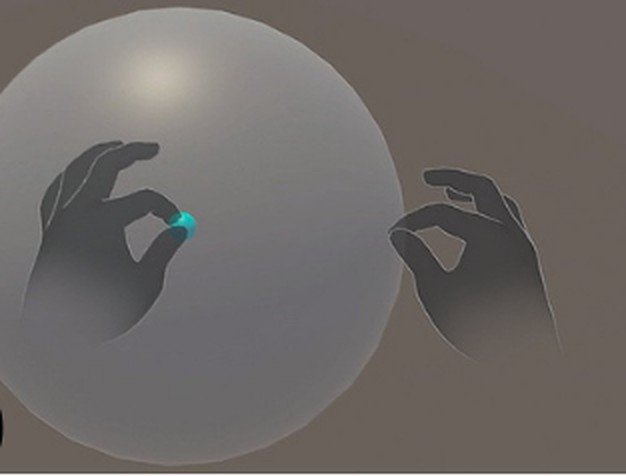
Data exploration in VR often requires selecting and manipulating many objects at once, but barehand
multi-selection techniques — especially two-handed ones — were largely unexplored.
Approach
I designed four mid-air multi-selection techniques spanning symmetric and asymmetric roles for the two
hands, and compared them in a controlled study (n = 20). A follow-up study (n = 21) extended the techniques
to multi-object manipulation of 3D graph data.
Findings
The symmetric-synchronous technique matched the asymmetric ones on efficiency, accuracy, and throughput
for within-reach targets — and was the technique participants preferred.
My role
design of the four multi-selection techniques
Unity study apparatus for both studies
study execution (n = 20 and n = 21)
quantitative analysis
writing
Publications
IEEE International Symposium on Mixed and Augmented Reality (ISMAR), 2024
Habibi, P., & Chattopadhyay, D. Bimanual, Mid-Air Multi-Selection Techniques in Virtual Reality.pdfieee
ACM CHI Conference on Human Factors in Computing Systems, Extended Abstracts (CHI EA), 2026
Habibi, P., & Chattopadhyay, D. Bimanual Mid-Air Multi-Object Manipulation of Graph Data with Gesture Phrasing.pdfacm
Explanations of graph neural networks are usually built for the people who train models — not the AI
experts and domain experts who must act on them.
Approach
Working with both groups, we derived design requirements for human-centered GNN explanations and built an
interactive 2D probe over real-world graph data to study how experts explore explanations in practice.
Findings
The paper contributes a design-requirements framework built on three pillars: 3D visualization for spatial
awareness, interactive modalities for exploration and feedback, and human-in-the-loop refinement connecting
expert input back to the model.
My role
requirements analysis
design of the interactive explanation probes
writing
Publications
Human-Centered Explainable AI (HCXAI) Workshop at the ACM CHI Conference on Human Factors in Computing Systems (CHI), 2024
Habibi, P., Baghershahi, P., Medya, S., & Chattopadhyay, D. Design Requirements for Human-Centered Graph Neural Network Explanations.pdfarxivworkshop
University of Illinois Chicago · 2024 – 2025
think-aloud · N = 20 · VR · under review
Problem
Explainable-AI methods can produce mathematically faithful, well-visualized explanations of model
predictions. Far less was known about whether people reason with these explanations or simply accept
them — and about how beliefs form and update as people explore an explanation.
Approach
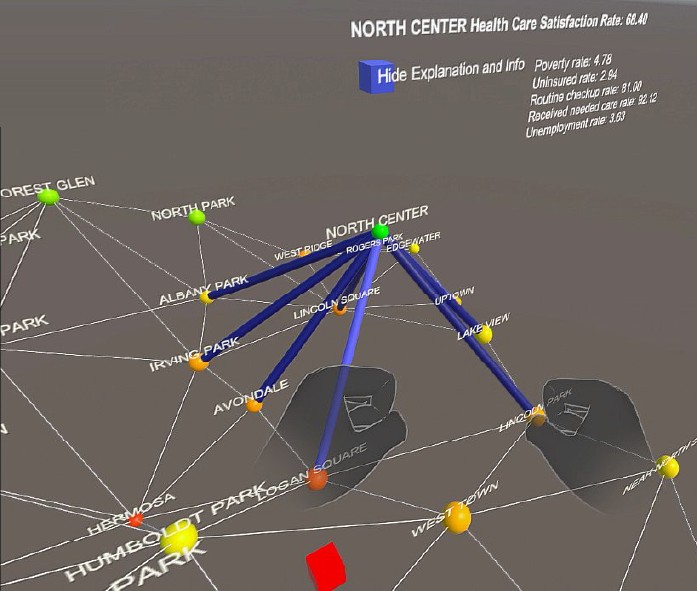
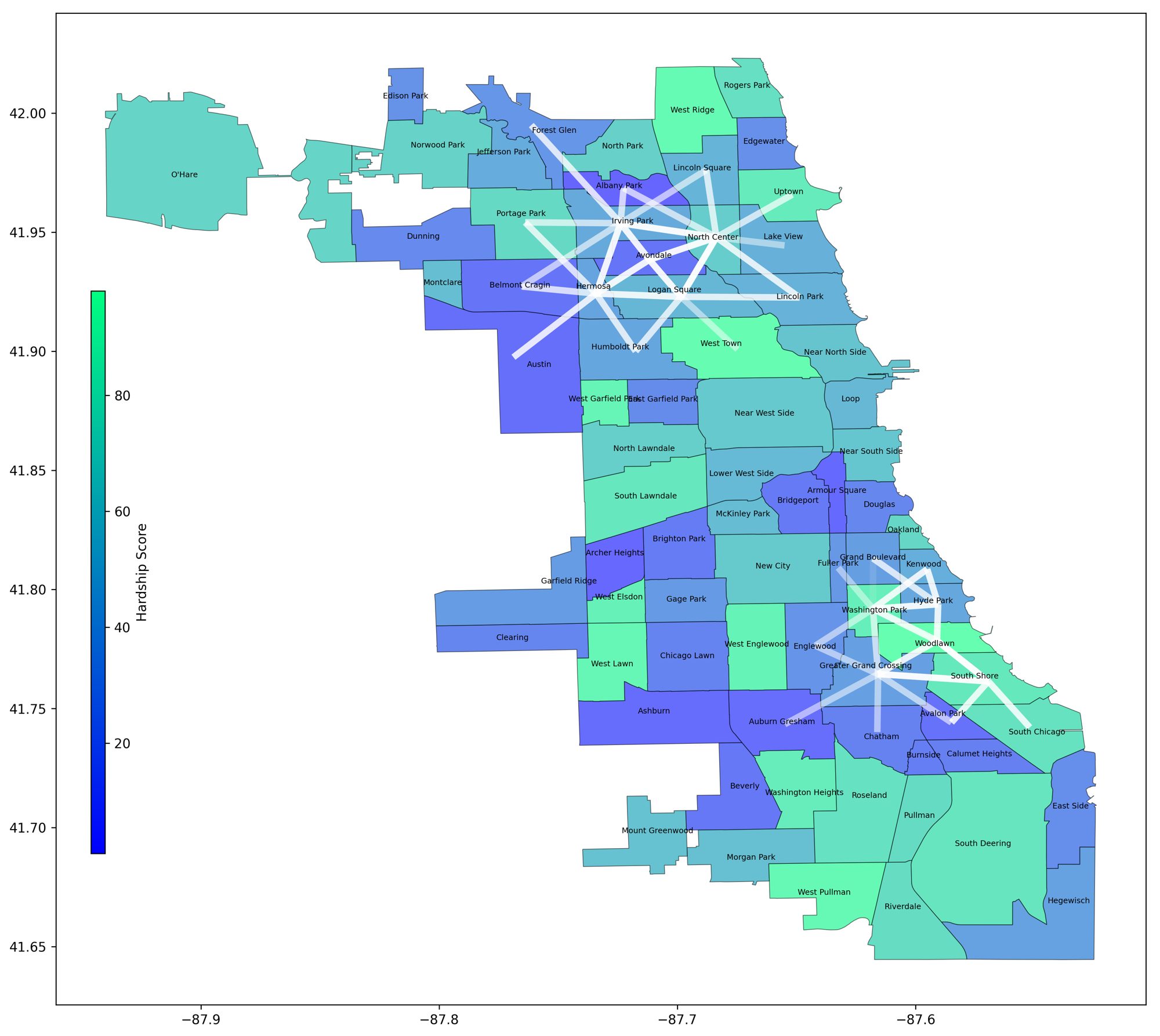
We trained a GNN to predict healthcare satisfaction across 77 Chicago neighborhoods, then ran a
qualitative think-aloud study (N = 20) in which domain experts (long-term residents) and AI experts explored
the model’s explanations in an immersive 3D environment — chosen for spatial depth, embodied interaction, and
relief from the visual occlusion of dense subgraphs. Analysis used a belief-understanding framework
distinguishing belief formation from belief updating, operationalized through a qualitative codebook.
The interactive 3D study environment.
Findings
Expertise shaped belief work: domain experts formed beliefs by recalling their own knowledge of the
neighborhoods, while AI experts sought evidence independently through structured reasoning strategies. Both
groups experienced cognitive stagnation when explanations lacked context — explanations functioned as static
endpoints rather than prompts. The results argue for explanations that act as interactive prompts for
iterative belief updating, the premise of my current narrative-explainability work.
My role
study design (think-aloud protocol, N = 20)
study execution with both expert groups
qualitative codebook and analysis
writing
Habibi et al., Understanding Belief Dynamics in Visually Interactive Explanations of
AI Predictions — under review, 2026.
University of Illinois Chicago · 2019 – 2024
interviews · design probes · N = 20 · React
Problem
Patients with chronic heart failure often leave the hospital with discharge instructions they cannot use:
long, generic, and written well above a comfortable reading level. Hospitals are now adopting generative AI
to draft this documentation — which makes getting the design right more urgent, not less.
Approach
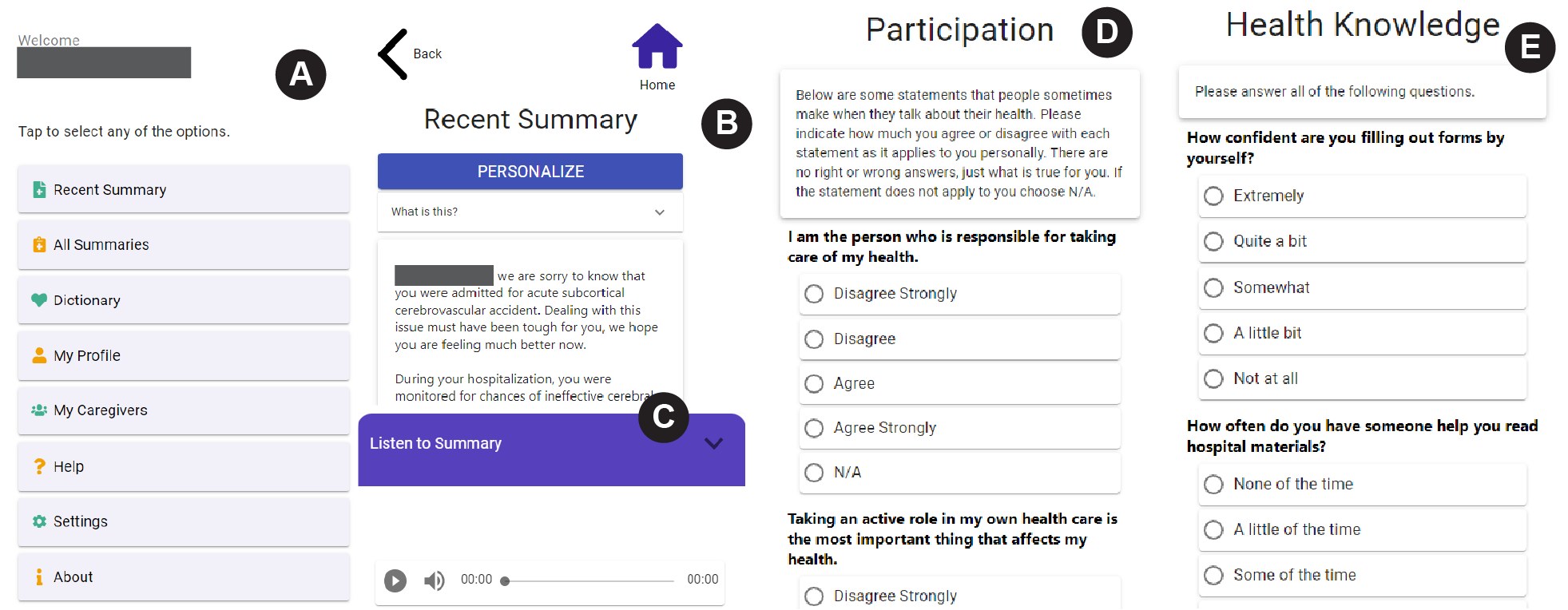
myPHA gives patients a personalized, readable account of their hospital stay, generated from clinical
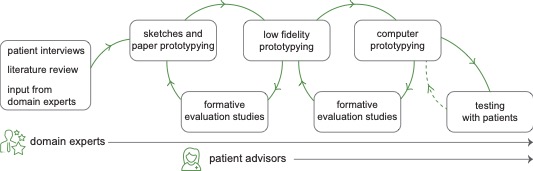
records and tailored to their engagement and health literacy. The design ran the full arc with domain
experts and patient advisors involved throughout: patient and clinician interviews, sketches and paper
prototyping, low-fidelity and computer prototypes, formative evaluations, and testing with hospitalized
patients. The design is grounded in a corpus of 53 in-hospital interviews with heart-failure patients,
annotated along five dimensions to surface patients’ strengths, concerns, and engagement — and most recently
an inpatient interview study with 20 adults hospitalized with chronic heart failure, including task-based
design-probe activities with a digital discharge summary. The work was funded by NIH/NCI R01 CA225446
(2019 – 2024), with an interdisciplinary team across computing, linguistics, nursing & medicine.
The design process, from interviews and literature review to testing with patients.
Findings
Engagement with today’s discharge summaries is strikingly low: of 20 hospitalized participants, only two
had ever opened their digital summary after discharge. Participants preferred listening over reading and
wanted easier ways to share information with caregivers. We translated these findings into patient-centered
design recommendations for AI-generated discharge summaries: reduce navigational burden, provide multimodal
access, and make sharing easy.
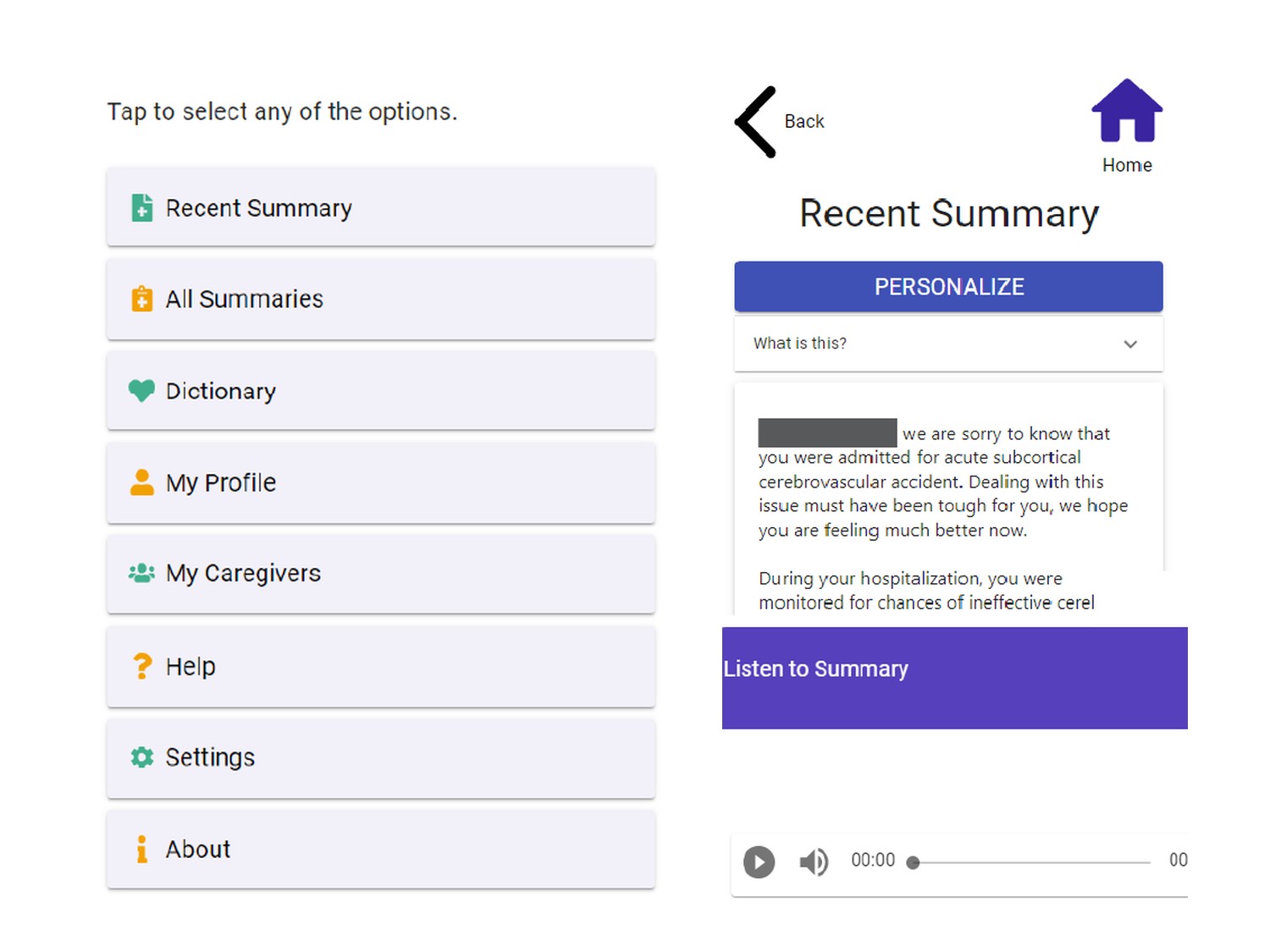
The design probe used in the inpatient study: menu, personalized summary, listen-to-summary, and in-app questionnaires.
My role
design lead across the project arc
patient and clinician interviews and analysis
prototyping across fidelities — from sketches and paper prototypes to the working React app
formative evaluations and the inpatient design-probe study
Publications
IEEE International Conference on Healthcare Informatics (ICHI), 2026 · Outstanding Paper Award, Human Factors track
Habibi, P., Vatani, H., Landes, P., Di Eugenio, B., et al. Patient-Centered Design Recommendations for AI-Generated Discharge Summaries.pdf
Research in Nursing & Health, 2021
Dunn Lopez, K., et al. (incl. Habibi, P.) Improved Readability and Functions Needed for mHealth Targeting Patients with Heart Failure.pdfwiley
Annual Meeting of the Special Interest Group on Discourse and Dialogue (SIGDIAL), 2019
Acharya, S., et al. (incl. Habibi, P.) A Quantitative Analysis of Patients’ Narratives of Heart Failure.pdfacl
American Medical Informatics Association (AMIA), 2019
Vatani, H., et al. (incl. Habibi, P.) Patients’ Perceptions of Heart Failure Through the Lens of Standardized Nursing Terminologies.pdf
IEEE International Conference on Biomedical & Health Informatics (BHI), 2019
Acharya, S., et al. (incl. Habibi, P.) Promoting Patient Engagement Through Personalized Hospital-Stay Summaries.pdf
Workgroup on Interactive Systems in Healthcare (WISH) Workshop at the ACM CHI Conference on Human Factors in Computing Systems (CHI), 2019
Habibi, P., et al. Designing Self-Care Technologies for HF Patients: A Conceptual Model.pdfworkshop
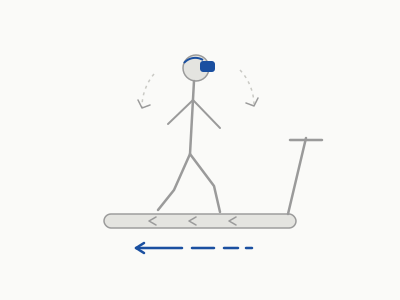
UIC Locomotor Rehabilitation Lab · 2020 – 2021
VR · treadmill · error augmentation
I built and studied a VR-based assessment of standing balance,
and asked whether error augmentation — deliberately exaggerating a learner’s errors during practice — can help
skills learned in a virtual environment transfer to the real world. The work combined VR development with
experiment design for a clinical research context.
University of Illinois Chicago · 2024
field research · community events
Not adoption but retention: we studied the sociotechnical barriers older adults face in the
continual use of digital apps and services, through community events that offered digital-literacy
support and tech help while letting us learn about their technology use. Field research: observation,
conversation, and support sessions with older adults in their own community settings.
Course project · Human-Computer Interaction (CS522), University of Illinois Chicago · 2020
heuristic redesign · Adobe XD
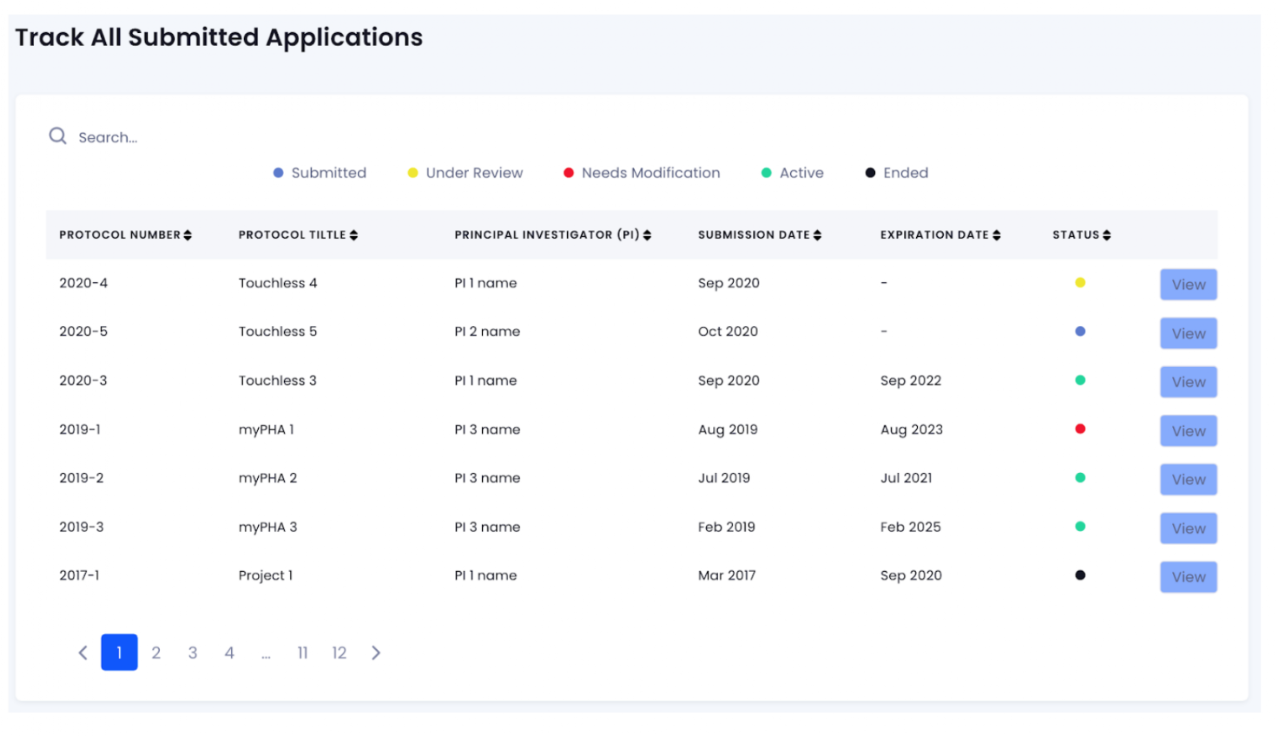
OPRS Live is UIC’s research-protocol submission website — the system every researcher at the university must
use to submit and track IRB protocols. The goal was to redesign the user experience of the desktop site.
Approach
The core change starts at the homepage: instead of listing all possible actions for everyone, the redesign
is built from cards with relevant actions and information personalized to each user — for example, a direct
link to track a recently submitted application.
Course project · Human-Computer Interaction (CS522), University of Illinois Chicago · 2020
wearable UX · Adobe XD
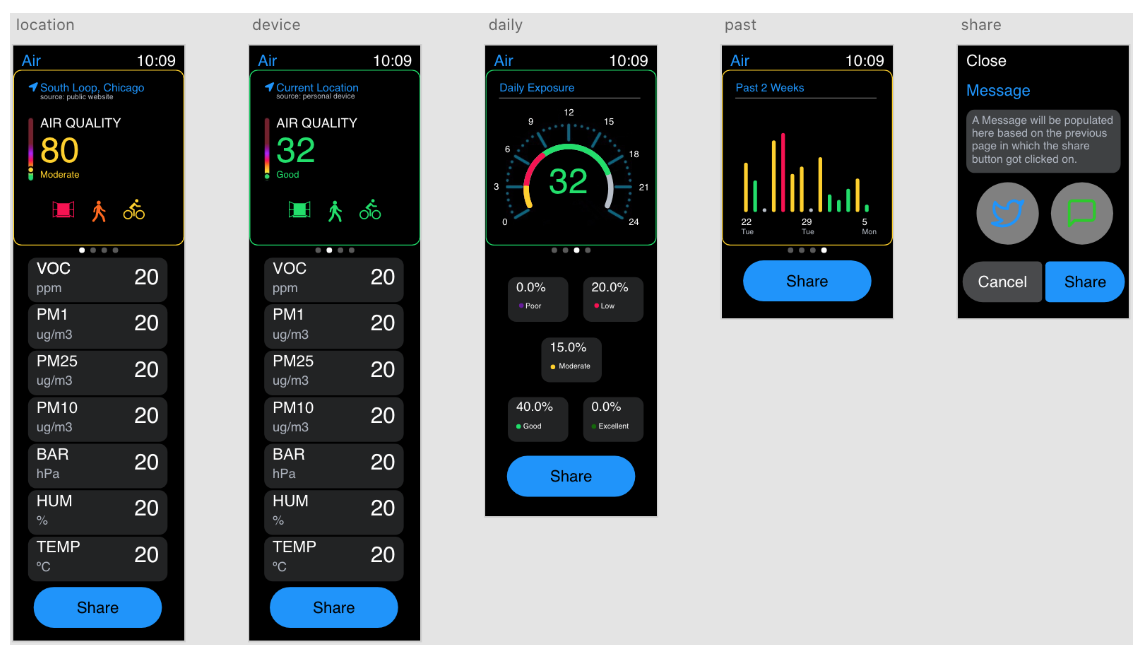
A smartwatch app designed to accompany a personal air-quality monitoring device, assuming real-time ambient
data (particulate matter, volatile organic compounds), a geotagged personal history, and cumulative exposure
data. Three design objectives: awareness about air quality; sharing that awareness to foster public awareness;
and persuading users to reduce long-term exposure.
Approach
Awareness. The main screen shows the AQI from the user’s own device, with color for the condition;
swiping left shows the wider area, and index-literate users can scroll for individual measures.
Sharing. Every page has a share button that opens a prepopulated message and image based on that page’s
content. Reducing exposure. Swipes to the right show daily exposure by hour and a two-week history, plus
activity suggestions — walking, biking, opening windows — based on the current AQI.
Course project · Virtual Reality (CS528), University of Illinois Chicago · 2020
Unity · CAVE2 · Vive
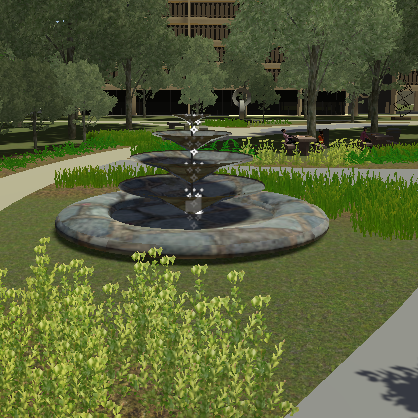
A virtual reconstruction of part of the UIC campus, running on both CAVE2 and HTC Vive, with a day scene and
a night scene. By day: a lunch crowd, a piano player, a basketball game, and a robot exhibition. By night: a
movie night with WALL-E on the big screen, popcorn for sale, and someone dozing in a hammock.
Interaction, sound, and animation
Three interactions (fountain on/off with particle effects, a robot you can switch on and rotate, popcorn you
can grab and place), layered sound (ambient day/night tracks, positional sources, characters who speak when you
approach), and animated people and vehicles. Fifteen of the models are my own, from furniture and lights to the
Taylor Street car and the creature robot.
CAVE2 versus Vive
Running the same application on both platforms made their trade-offs concrete: CAVE2’s wider field of view,
visible body, easier collaboration, better tracking and far less motion sickness — against the Vive’s lower
cost, easier setup, and stronger immersion. Frame rates and sound were better in CAVE2; both felt smaller than
the real campus.
Course project · Virtual Reality (CS528), University of Illinois Chicago · 2020
experiment platform · 7 conditions · Unity
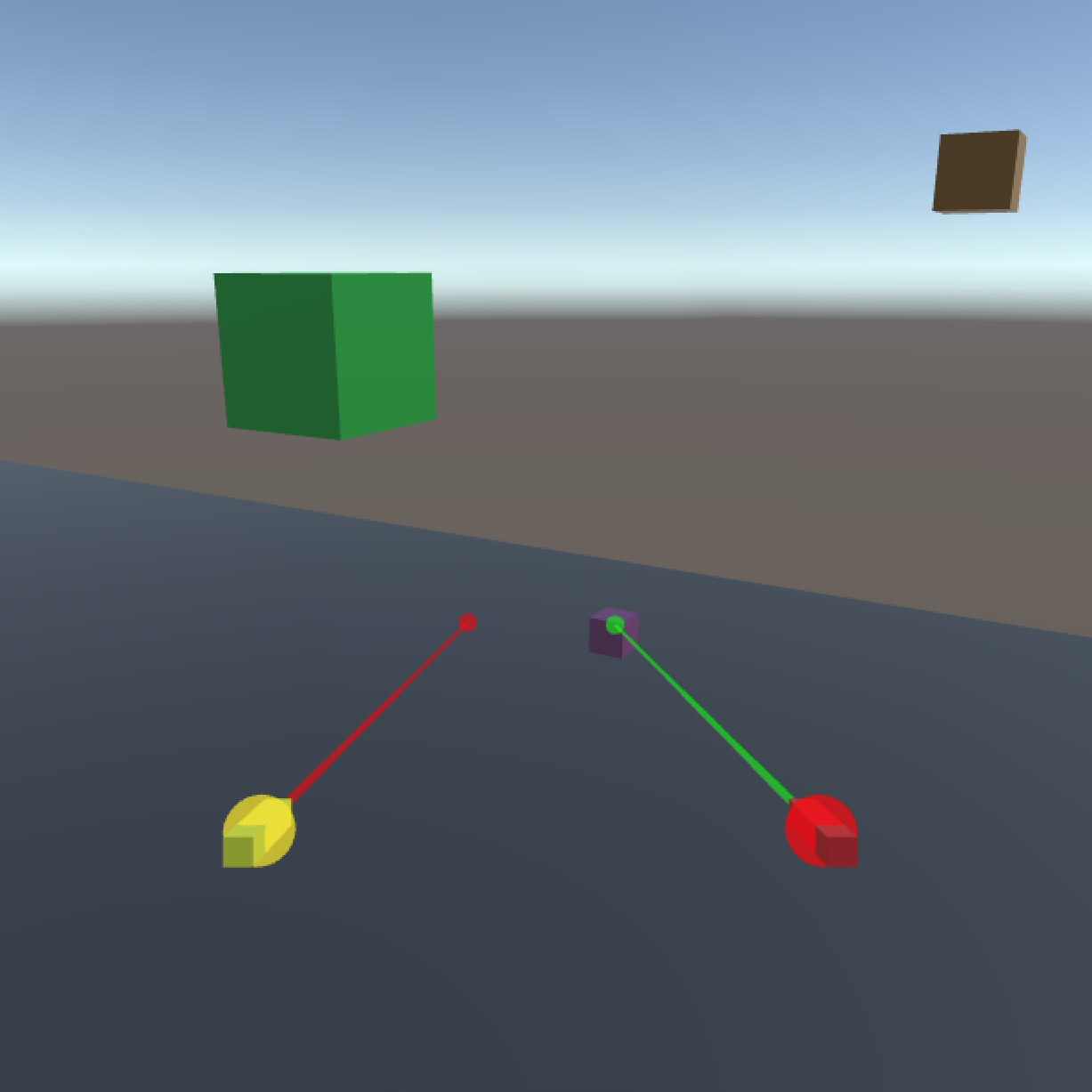
A VR application built for a study of point-and-select performance under different walking conditions —
including whether people use their left controller for objects on the left side of their body. The setting is a
hallway of selectable cubes; a ray changes color for visual feedback and sounds confirm correct and incorrect
selections.
Study design
Seven conditions cross walking mode with controller assignment; each condition presents six target sets
(three widths × two densities, half per side), randomized within condition and Latin-square ordered across
conditions. Within-subject design with training, interviews, and NASA-TLX; logs capture completion time,
errors, and selection hand per target — a planned 12,600 trials analyzed with linear mixed-effects models.
Course project · User Interface Design and Programming (CS422), University of Illinois Chicago · 2018
replication · web platform · interaction logging
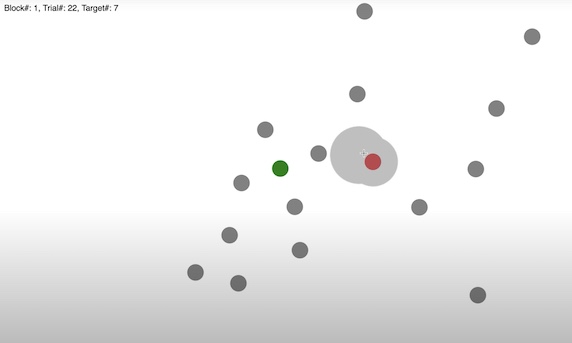
I rebuilt the controlled experiment from the published Bubble Cursor paper as a web platform, ran the study
with participants, and analyzed the logged interaction data — research engineering in miniature: stimulus
control, data logging, and the stats.
Course project · User Interface Design and Programming (CS422), University of Illinois Chicago · 2018
personas · paper prototyping · computer prototype · usability testing
Problem
People who share a living space also share responsibilities — cooking, cleaning, groceries — plus the
communication and debt-settling that come with them. Many apps handle one of these tasks; none handled
them all in one place, and the coordination overhead breeds conflict.
Approach
We defined two user classes — students and working professionals sharing a space — and built personas
around their goals and frustrations (single platform, effortless scheduling, quick settling of dues; tired of
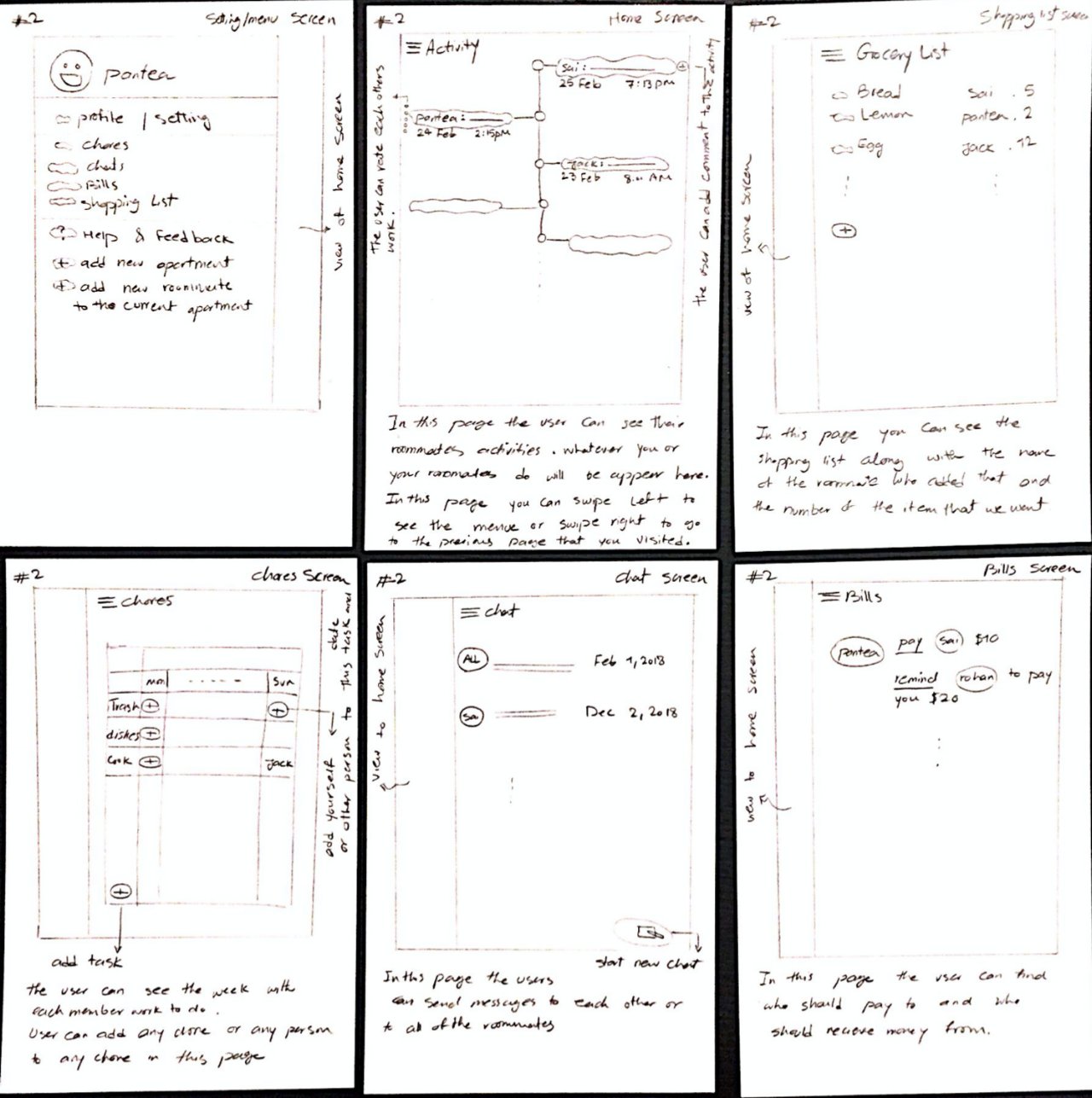
nagging roommates across four different apps). Design ran through competing sketches, paper prototyping, and
a working computer prototype — built with React Native for mobile and React for web — evaluated with users
at each step.
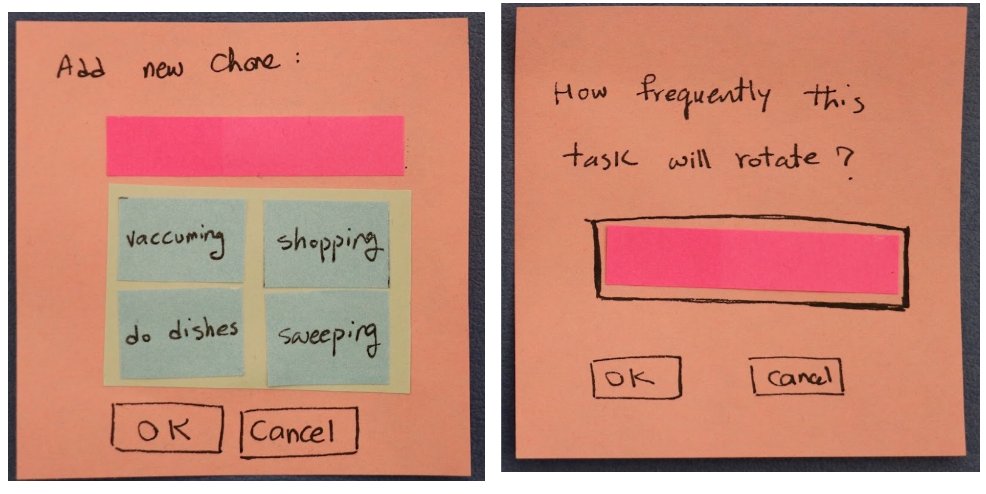
One of three competing sketch directions: activity feed, grocery list, chores, chat, and bills.Paper prototyping the add-a-chore flow, including chore rotation.The evaluated prototype: a gamified chore board with a weekly winner, a debts timeline, and chat.
My role
sketching competing design directions
paper and computer prototyping
usability evaluations
University of Illinois Chicago · 2018
mobile concept · citizen science
Wildbook is a mobile app concept addressing volunteer retention in wildlife data collection: it aligns
what citizen scientists want out of the experience with what conservation research needs from the data.
Designed and prototyped as part of a citizen-science research effort.
Course project · Human-Computer Interaction (CS522), University of Illinois Chicago · 2020
Unity · VR
A VR application exploring upper- and lower-limb rehabilitation exercises.